February Cooking Tip – Pass the Chili’s Please!

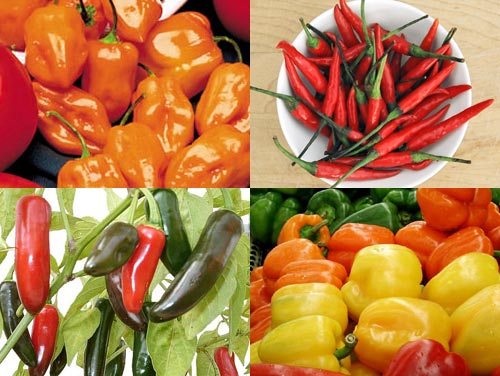
Chili’s come in a variety of sizes and shapes as well as a variance in hotness.  They are a fantastic source of Vitamins A and C as well as folic acid and carotenoids. 

Some people like it hot, some not.  If you are amongst those that like a ‘kick’ to your food, then you are one of the lucky ones.  Chili peppers, unlike sweet peppers, contain a substance called Capsaicin which gives the chili their hotness.  Capsaicin is not only ‘hot’ in your mouth but hot to the touch.   When cutting up a chili, especially one of the hotter versions like Scotch Bonnet, Habanero, or Chile de Arbol, make sure to wash your hands before touching your face, especially your eyes!

So what is so great about that Capsaicin?  It is a fantastic substance!  History and folk medicine used chili peppers for asthma, fevers, sore throats, and other respiratory tract infections, digestive disturbances, and cancers.[1] 

In addition, here are some of the great things capsaicin offers: 

  • It has been associated with having excellent antioxidant compounds
  • It increases metabolism, thus aiding in the burning of fat
  • Although seemingly hot, it actually has a cooling effect by lowering body temperature.  It simulates the cooling center of the hypothalamus in the brain.  This is why it is often common to find hot climates eating foods laden with chili peppers.
  • Is a potent inhibitor of substance P, a neuropeptide associated with inflammatory processes
  • Harvard studies show that it has the ability of blocking pain-receptive neurons without blocking other kinds of neurons that control other kinds of movements.  This work is related to the pain associated with arthritis and other inflammatory diseases[2]
  • It has beneficial effects on the cardiovascular system.  It reduces the likelihood of developing atherosclerosis by reducing blood cholesterol and triglycerides.
  • Research at the University of Tasmania[3] is showing it “has the potential to lower blood glucose and insulin levels, reduce the formation of fatty deposits on artery walls and prevent blood clots – minus some of the nasty side-effects of traditional medications.”

Cultures that consume chili peppers on a regular basis have healthy cardiovascular systems along with many other health benefits.  Maybe it is time to add more chili peppers into your daily diet. 

Get out your various chili’s and start adding them to your favorite dishes!  This months’ Chicken Soup is a great place to start!  https://healthandnutritionexperts.wordpress.com/2010/02/17/february-recipe-%e2%80%93-julie%e2%80%99s-easy-chicken-soup/


[1] The Healing Power of Herbs by Michael T. Murray, N.D.

[2] http://www.innovations-report.com/html/reports/medicine_health/report-13188.html, http://golgi.harvard.edu/NewsEvents/News/ug-award_hoopes_6-3-09.html

 [3] http://www.hls.utas.edu.au/news/2009chilli/

February Recipe – Julies’ Easy Chicken Soup

When having dinner with a friend last night, I was inspired to pull out the old Crockpot and make something healthy and easy.  I decided that a dish somewhere between a one-course meal and a soup would be the answer.   Of course, you might want to add a salad to get some greens in.

The great thing about this dish is that it also works fantastically for breakfast.  Now I realize most people don’t even think of soup for breakfast but, as I have found out in my Asian travels, soup is often not only a daily breakfast but an incredibly satisfying one.  So double the recipe or save some for a cold morning!

The other fun thing about this recipe is it uses a chili that can be found in most grocery stores.  It is little but packs a great punch!  It is called chile de arbol or also known as a Thai chile.  Here is a picture:

Ingredients:

2         Chicken thighs, bone in with skin

1          Chicken split breast, bone in with skin

1 T      Olive Oil

Pinch Celtic Salt & Pepper

1          Onion, chopped

3          Garlic Cloves, minced

½         Red Bell Pepper, chopped

1          Orange Bell Pepper, chopped

2-3      Chile de Arbol

2          Carrots, cut into ½” pieces

1          28 oz Can Diced, Fire Roasted Tomatoes[1]

12       Medium to Large Shiitake Mushrooms, stems cut, quartered ( more if desired)

1 T      Fresh Ginger, finely grated

1 C      Vegetable or Chicken Broth

1 T      Celtic Salt

            Pepper to taste

1 C      Dry White Wine, optional

Preparation:

Place olive oil in medium size sauté pan over medium/high heat.  Sprinkle all chicken with salt and pepper.  Place in pan, skin side down.  Cook until chicken is slightly browned.  Turn and do the same.  Remove.  Take out all but 1 ½ T oil from pan.  Add onions, garlic, bell peppers, and chili’s.  Sauté until onion starts to become translucent, approximately 3 minutes.

Meanwhile place carrots, tomatoes with juice, mushrooms, ginger, broth, salt and pepper in Crockpot.  Place chicken on top followed by sautéed vegetables.  Cook for 7 hours.  About hour 6 or just before serving, remove the skin and bones from the chicken.  Shred the chicken and return to the pot.  Adjust seasonings and add wine around hour 6.

Serves 4-6


[1] I prefer Muir Glen brand.

The Gift of Fitness

Cathy is a friend of mine that I have had the pleasure of learning from.  She has overcome something major in her life and I wanted to share her story with you as I find it very inspiring.  When you are struggling with health on any level read this article as it may help you take charge of your life!

The first thing members encounter when entering Iron Works Fitness during the day is a smile and a warm welcome from Cathy Grayell, the owner.  This is usually followed by a short conversation regarding the current goings on and any news worth sharing.  Cathy is always upbeat, and even looks the part of a health club owner.  She is fit, energetic, and is often found lifting weights or using other equipment.

There is more to Iron Works Fitness and Cathy Grayell than meets the eye. Fourteen years ago, Cathy was diagnosed with Multiple Sclerosis, a progressive disease that slowly eats away at the nervous system.  Cathy’s doctor predicted she would be in a wheelchair by the time she was 40.  She was also a mom with three young children to raise.  That was in 1992. Today, Cathy looks like a well-trained tri athlete.

Indirectly, Cathy credits her multiple sclerosis to opening her business. “Unless you are forced into new situations you might not do as much in life.  I probably wouldn’t have opened Iron Works unless I had already been pushed in different ways working with multiple sclerosis.”

“The concept behind Iron Works” says Cathy with an infectious smile, is “What kind of workout facility would you create in your own home if you had unlimited time, money, and space?” Another idea that helped form the approach of the facility was to allow 24 hour card key access.  “I’ve belonged to different clubs over the years” says Cathy, “And they always seemed to open too late, or close too early for my schedule.  If I did get in during regular hours, it always seemed that I had to rush to be done.”  The card key approach removes all those issues. “The members all really look after the place too,” she continues.  “They have taken ownership of the facility, which is great.  The members come in all ages shapes and sizes” she says proudly, “from elite cyclists to people in their late 60’s”.

Cathy loves talking about her relationship with members.  It is important to her that she knows the members, and she really enjoys connecting with them.  “I am kind of like a bartender sometimes” she says laughing.  “We talk about everything.”

It’s a whole different world for Cathy than in 1992.  At the time of her diagnosis, she was working a high stress job.  On her Doctor’s advice, she quit. At first, she listened to her doctors, rested most of the time, and took steroids.  Her physical condition worsened.  She had so little energy she could barely get up and take a shower without returning to bed. She admits it was very tough initially.  When she first heard the diagnosis, she “steam-rolled through things” to deal with it.

About this time something in Cathy changed.  She realized she had to take control of her own health, and it was a turning point in her life.  She told herself  “This is small-potatoes compared to raising three kids.”

“You have two options when you look at your place in the world” Cathy continues.  “You can look at it as either something was given to you, or something was taken away.  I have chosen to say something was given to me.” 

She started exercising.  She started walking 5 minutes.  After some time, she increased to 10 minutes of walking.  She got to the point where she could walk easily for an hour.  She also started listening to her body during this period, and she says this was the start of her journey to wellness.   Believing that a healthy body and mind are synergistic, she enrolled at CU and finished her undergrad degree in English begun many years ago at Penn State.  Obtaining her degree in 2000 after six years of being a part-time student and full-time parent gave her an even greater sense of accomplishment, physically and psychologically. 

Cathy has lived in Colorado since 1978 and in Boulder since 1990.  “Living in Boulder”, she says with an amused look on her face,” I had access to lots of alternative methods of treatment, and I tried everything.”  She is a firm believer in eating unprocessed food (this is her “medicine”) and being very tuned into her body.  She will still have flare-ups if she is too stressed or too tired.  She is a big believer in exercise, and credits this with her wellness.  She lifts weights three days a week and her current regimen includes a goal of participating in at least one century bike ride this summer and continuing to build her strength both on off the bike. 

Cathy has a positive outlook on all aspects of her life. Her journey to wellness brought her an understanding of the importance of incorporating and maintaining fitness as paramount to coping with whatever life offers. Through the lessons she learned, and the many difficult tasks she faced, she also learned she had a great capacity to accomplish difficult goals.   

She believes life has given her an opportunity to be available to people facing physical challenges, and she is eager to share this gift of fitness with others.  That is why Cathy can be found most days at Iron Works Fitness where she helps hundreds of members along their own path to wellness.

Iron Works Fitness is located at the corner of Yellow Pine and North Broadway, in the Holiday Project.  You can learn about their facility at www.ironworksfitness.net, or by calling Cathy at 303-539-9334.

January Cooking Tip – Enhancing Flavors in Soup & Chili

If you would like to make your soups and chili’s more flavorful, here are two simple things you can do that really make a huge difference:

  1. Finely chop any vegetables.  When vegetables are cut into small, uniform pieces, they cook more quickly and evenly, and also release a good deal more flavor, than large irregular cuts.
  2. Prepare the day ahead.  The nice thing about this is that you can plan ahead and make a soup or chili ahead of time for one of those nights (or breakfasts) that you don’t have the time to cook.  In addition, by allowing time, the flavors will have a change to integrate and become richer.

January Recipe – Veggie Bean Chili with Espresso

My friend Jeff Berman is an amazing cook.  So, when I started to think about who I could consult on vegetarian, easy, healthy meals, his name came to mind first.  He generously offered me his recipe for chili.  I just made it this weekend and love the complexities of tastes.  I do have one comment… it may have been the chili powder I used, but it was HOT!  So, depending on your personal tastes, you might want to decrease the amount you put in. 

Ingredients:

½ C     Extra Virgin Olive Oil

3          Onions, chopped

1          Large Red Bell Pepper, diced

¼ C     Instant Espresso Coffee

¼ C     Ground Cumin

¼ C     Chili Powder

¼ C     Dried Oregano

2          Large Cans of Diced Tomatoes[1]

½ C     Honey

6          Large Garlic Cloves, minced

5          Cans of Beans – a mix is nice – kidney, black, red

½ C     Water

1½ C   Dry Red Wine

¼ tsp Ground Cinnamon (optional)

1          Chipotle Chili in Adobo Sauce, minced

            Celtic Salt & Pepper to taste

Toppings (optional):

Sour Cream

Grated Cheddar Cheese

Preparation:

Heat oil in a large pot over medium/high heat.   Add the onions and red bell pepper and sauté 5-8 minutes, until they are softened.  Add the coffee, chili, cumin, oregano and garlic and cook for 1 minute.  Add the tomatoes and honey.  Bring to a boil, reduce to medium/low heat, cover and simmer for 30 minutes.  Add the beans, water, wine, salt, pepper, cinnamon, and chipotle.  Bring to boil, reduce to medium heat and simmer uncovered for another 30 minutes; stirring as needed.  Adjust seasonings as desired.

This is best if made the day before to enhance the flavors.

Serve with a dollop of sour cream or some grated cheddar cheese.

Makes a big batch so great for a crowd or to freeze for additional meals.


[1] Muir Glen brand is organic and enamel coats their cans so the tomatoes does not give off BPA from the plastic!

5 Ideas for New Year’s Resolutions

We are always thinking of ways in which we can lose weight, eat better, exercise more, and so on. 

How often do we think outside of that box?  Here are some ideas for making our lives and the planet healthier!


1.     Change the Way You Eat

Idea #1 – Make it a point to sit down with friends and family for at least three meals per week.

With the change in schedules and the availability of fast food, our society has moved far away from the relaxing social meals of the past.  When eating with friends and family, we eat slower because we are talking and enjoying the conversation.  Not only will we feel better physically but we will be filled much more emotionally. 

Unfortunately it is not only our country that is compromising the way we eat.  In John Robbins book, Healthy at 100 he notes the following:

 “In almost every culture in the world, eating dinner together has been a place for families to strengthen bonds.  The French in particular have long cherished mealtime as a family ritual, so much so that children have traditionally not been allowed to open the refrigerator between meals.  But the days of sitting for hours around the table savoring small portions of several courses and relishing each other’s company seem to have passed.  Instead, it has become commonplace for the French to eat in front of their television sets, while talking on the telephone, and even alone.   As McDonald’s has become more popular in France than anywhere else in Europe, the average French meal, which twenty-five years ago lasted 88 minutes, has been reduced to only 38 minutes today.”

Idea #2 – Stop eating in the car, in front of the television, or standing at the counter.

Our digestive system is not meant to adapt under any of these circumstances!  When we sit down, relax, focus on our food, and breathe, our bodies are prepared to produce the appropriate amount of digestive enzymes and we get the most benefit (nutrients) out of our food.  Part of the reason we overeat is due to these unconscious methods of eating.  We hardly chew our food and inhale it at such a rate that our brains have yet received signals that we are actually full.  Consequently we overeat and feel bloated and gain weight.  The crazy part about the whole process is we have no idea just how much this type of eating has compromised our health.

If this is you, maybe one of your resolutions is to make the time to sit down, relax, and take a few deep breaths before taking your first bite.  Appreciate the amazing fact that food is our lifeline to health.  Enjoy it fully.

Although this has sounded crazy to most people that know me, even if I am alone at home for dinner, I actually prepare a delicious nutritious meal, pour a nice glass of wine, set the table, light a candle or two and really enjoy the time of eating a wonderful meal in a relaxed setting.  I   am sure this sounds off the charts for many of you but I encourage you to try it once or twice.  It is a great experience!

Idea #3 – Learn about Slow Food

 Slow Food is a movement that counters fast food.  It is about creating a way of eating and living that associates the pleasure of food with community and the environment.  There are many Slow Food movements throughout the world.  Here a some sites to learn more:

Slow Food USA

Slow Food CU

2.     Change your Shopping Habits

Idea #1 – Stay out of the middle of the grocery store!

The most natural and healthy foods are found around the periphery of the store.  You will find the most nutritious and least processed foods in this area.  Not only is the food more processed as you wander down the aisles but can be more expensive.  Plus the amount of packaging adds to the increase in waste products in our landfills. 

Idea #2 – Take a list and Do NOT go when you are hungry!

I realize that neither of these ideas are new yet can save you a lot of money and keep you on a healthier track of food.  Think about what you would like to make and jot down the ingredients you need.  Make it an intention to get only those ingredients.  Of course if you see some great sale on fruit or vegetables you might want to get extra while you are there.  The main thing you want to avoid is picking up that junk snack food that you know isn’t good for you and yet is so tempting when you are hungry and just mindlessly wandering the aisles of the store.

Idea #3 – Change one/two buying habits into healthier choices.

 Although eating organic and antibiotic free meats can be expensive, in the long run it is cheaper than eating a bunch of junk and ending up sick!  Besides, by watching for specials in the produce, meat and fish section of the stores, you can find deals that are worth the purchase.  For example, not too long ago the Whole Foods in Boulder had grass fed ground beef on sale at an amazingly cheap price.  Now I don’t often eat ground beef but at that price it was worth purchasing it and keeping it in my freezer for that unexpected time I might want to make something with it. 

The same goes for produce.  Although you can’t necessarily store it, there are certain foods that I (now) only buy organic.  The reason being is that certain plants are sprayed much more with pesticides and the produce absorbs more of it.  Two examples are strawberries and spinach.  I only buy these if they’re organic! 

So start with one or two things that (you feel) are easy to change in your diet.  Maybe it is organic produce or antibiotic free chicken, whatever it is, it will have a positive impact on your overall health over time.

3.     Become a Part-Time or Full-Time Locavore!

What is that you ask?  The term Locavore started in the San Francisco area not too many years ago.  The premise was to encourage people to only purchase food that has been grown within a 100 mile radius of where you live. 

Eating local foods is a great step towards saving our planet and increasing our health.  When you purchase food that is grown within 100 miles of home, you are helping the environment.  It requires much less fossil fuel to get it to the store!  In addition, the food is much fresher as it is picked when ripe, thus allowing time for all the nutrients to get into the food.  You are also eating foods that are in season; something we are designed to do.

Although this might not always be easy, start with your local Farmer’s Market.  You will meet some great people – the farmers and ranchers.  You will find you have a much greater connection to the person growing your food, the food will taste amazingly so much better, and you will feel a greater part of the whole food chain.  If you are in a cold climate where this is only available in the summer, start there and get to talking to the farmers.  Chances are that many of them will be able to provide you with food in the winter months as well. 

I have found a local organic farmer, Jay Hill Farm that grows greens and various other produce all winter long.  I just have to email her and it will be picked the following morning and ready for pick up after 11am.  I have made salads with her mixed greens and arugula for many friends and family.  I always get the same reaction, ‘wow this is the best salad I’ve ever had!’  In so much as I would like to think it is my amazing ability to make a salad, I know better.  The main difference is the fresh and vibrant taste of the greens!

Want to learn more about the ‘locavore’ movement?    “The “locavore” movement encourages consumers to buy from farmers’ markets or even to grow or pick their own food, arguing that fresh, local products are more nutritious and taste better. Locavores also shun supermarket offerings as an environmentally friendly measure, since shipping food over long distances often requires more fuel for transportation.”

Read this for a full description from Oxford.                                                                                                                                 

For ideas of the closest Farmer’s Market and where you can find local ranchers, here are some websites:

Local Harvest is a great source for finding food grown close to you.

This USDA site might offer you some farmer’s market information.

Eatwild.com is your source for safe, healthy, natural and nutritious grass-fed beef, lamb, goats, bison, poultry, pork, dairy and other wild edibles.  You can go here to find ranchers in your area.

If you can’t find one, the U.S. Wellness Meats in an alternative place to get grass fed meat and more.

4.     Change your Water Drinking Habits

 Idea #1 – Purchase water in larger quantities and fill your own bottles.

To begin, water is life.  Without it we will die and yet we don’t drink enough.  Many people are walking around dehydrated and don’t even know it.  For more details on signs of dehydration and more on the benefits of drinking water, read this article.

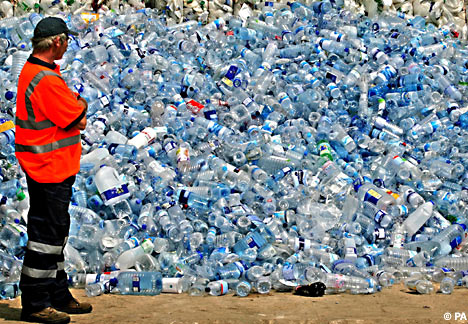
Meanwhile there are many more people drinking water-like products than ever before.  First, many of those are processed and have various types of sugar and more.  Rather than purchase these expensive products drink good water!  Second, realize the environmental consequence of using all those bottles!  Here is a very dramatic slide show revealing the tragedy of the plastic bottle on our environment.

Watch this slide show –  water-disaster !

Last, if you do not have good water available in your area, purchase a water filter.  There are many types on the market and are worth the cost.

Idea #2 – Purchase a healthy reusable bottle for your water.

BPA is a chemical that is found in hard plastic.  It is very toxic and has been proven to cause major health problems.  Although more companies are aware of this and changing their bottles, not all are there yet.  If using a plastic bottle, look for one that says, “BPA Free.” 

One of the companies that have taken on this change is Nalgene.  I really like their bottles as they have a variety of designs to meet everyone’s needs.  If you cannot find them locally, here is their website

The second option is to use one of the Swiss made bottles.  They are stainless steel on the inside so no worries about the plastic.  Again you might be able to find these locally but if not, here is their website.   

5.     Find Ways to Help Sustainability and Decrease your Carbon Footprint 

In addition to the aforementioned, here are some relatively easy things you can do that have a positive effect on our environment. 

Idea #1 – Decrease the amount of animal products you eat.

One of the ways we can have the greatest impact on our planet is to change our diet towards a vegetarian one.  Now I am not proposing that we all give up animal products.  I personally cannot imagine doing this and yet I am very impressed by those that have.

What I do realize is that even with eating grass fed and antibiotic free beef, cage free and natural chicken, and non-farmed fish, we are still using a great deal of the resources available on our planet.  According to the United Nations Food and Agriculture Organization, “Livestock production is responsible for more climate change gasses than all the motor vehicles in the world. In total, it is responsible for 18 percent of human induced greenhouse gas emissions. It is also a major source of land and water degradation.”

So what do we do about this?  Well, my goal is to start by having one day a week that I eat no animal products.  I will then work towards two days.  If each of us gave up one or two days a week, we would have a huge impact on our planet.  With this being said, I intend to put more vegetarian recipes on my website!

The Toronto Vegetarian Association has some good information for you.

Idea #2 – Change your lIghtbulbs!

As your light bulbs burn out, replace them with Compact Fluorescent Light Bulbs.  They are 75% more efficient and last 10 times as long. 

Idea #3 – Start unplugging what you are not using!

Unplug lights, stereos, printers, heaters, and anything else when not in use.  Even if the units are turned off, many of them continue to use energy.  The only way you can be assured they are not is to unplug them from the wall.  It only takes an extra second but can have a huge impact on our energy output.

Idea #4 – Recycle!!!

Make it a goal to have a minimal amount of non-recyclable trash.  Last year I made my goal to not have more than one (kitchen) bag of trash for two weeks.  So far I am there all but those times that I have a big party.  Once you get in the habit it is really easy.  If you have a local recycling program, learn about all that you can recycle.  If you are lucky enough to live in a place like Boulder, then you also have compostable recycling.  If not, get a bin and start composting.  Here is some information on how

Idea #5 – Buy products with the least amount of packaging. 

As mentioned earlier, if you stay along the periphery of the store, you will find the packaging to be at a minimum.  Even at this however you need to think!  I do see these plastic containers for spinach and mixed greens.  Don’t buy them!  Instead buy in the bulk. 

To support this concept even more, I just purchased some reusable vegetable bags.  I haven’t tried them yet but am excited to decrease the amount of plastic bags I accumulate.  Check out their website

Idea #6 – Use less paper products.

Two ways that are extremely easy is in the kitchen.  Rather than purchasing paper napkins, get some really nice cloth ones.  It is a much nicer feel on your mouth and hands and they last forever!  I still have the original ones I bought about 25 years ago!  (I use them for outside picnics and camping.)

The other easy change is in using dish towels rather than paper towels.  Dish towels or sponges are great and can be reused for a long time.  Of course we do still need some paper towels but not so many. 

Idea #7 – When purchasing paper products, buy recyclable ones!

You can avoid the bleaching process and save the trees!  “ If every household in the United States replaced one roll of virgin-fiber paper towels with 100 percent recycled paper towels, we could save 1.4 million trees.”  Source:  Care2

Idea #8 – See how you’re doing!

Calculate your Carbon Footprint now and then again every few months.  There are a lot of different sites to figure out this process, just search for carbon footprint calculator.  This one is pretty simple but a good place to start – The Nature Conservancy

If you have information or ideas that are along these thoughts, please share them!  I look forward to hearing from you and HAPPY NEW YEAR!!!

Julie

Stress and the Benefits of Massage

Stress is just part of living.  Some stress is good.  This type of stress is called “eustress” and results in things like motivation, feelings of excitement and improving performance.  The other, more common type of stress  is “distress” which can initially cause the same response but over time plays havoc on our bodies.  (To learn more about this type of stress read, The Effects of Stress.)

In this prolonged situation of distress, we tend to hold our bodies in a tight or contracted state.  Our breath shortens and our muscles start to ‘hold’ onto that tightness.  Often we carry our stress in certain parts of our bodies.  The more common areas are shoulders/neck, low back and the abdominal area. 

At first we don’t really pay much attention to the fact that we are tightening that area.  It is at an unconscious level.  However over time those muscles that are continually contracted start to cause us pain or discomfort.  Hopefully this wakes us up! 

The cycle looks something like this: 

  • We become stressed out about something.
  • We then hold tension unconsciously in certain muscles. 
  • Those muscles are contracting for an extended period of time. 
  • The more they contract, the more waste products they produce. 
  • Meanwhile, when they contract, they limit the amount of blood that flows to them.  This is known as vasoconstriction.
  • Since there is a lack of blood flowing to the muscle, the waste products cannot be flushed out but rather accumulate in the tissues. 
  • This causes an irritation to the nerve endings and the result is PAIN.
  • Along with pain comes more tension.
  • Then the cycle continues to move beyond the original tight muscles into the surrounding muscles.  This is the body’s way of protecting itself.
  • Those muscles start to stay contracted and the pattern starts all over again in those outlying muscles.

As you can see, this cycle can go on and on.  In addition to pain, often we end up with other symptoms like headaches, numbness, fatigue, weakness, stomach aches, or shortness of breath; just to name a few.  Over an even longer period of time, say months or years, we start to develop symptoms that lead us to believe something bigger is wrong with us.  At this point it can be incredibly difficult to reverse this process and yet not impossible by any means.

This is where therapeutic massage comes in. 

Massage that works on a level deep enough to affect the tightness (without going too deep) can be very beneficial.  It assists in bringing fresh blood to the tissues thus allowing the waste products to move out while at the same time bringing nutrients to the muscles to help them heal.  It also works on a neurological level to affect the proprioceptors. 

Proprioceptors are found throughout our entire body.  The ones located in the muscles act as messengers to the brain to tell it to either shut off the contraction or to turn it on; depending on which proprioceptors we are talking about.  Those found in the tendons, near the insertion of the muscle into the bone, are called Golgi Tendon Organs or GTO’s.  Their work is specifically to help the muscles relax by sending messages to the brain to stop the contraction within the muscle.  This is just one simple example in a very complex situation.

In addition to the physical therapeutic benefits of massage there is the emotional.  Often along with stress comes a hurried life with little to no time to stop and take care of ourselves.  The more we push to avoid the situation, the more we create the havoc.  Therefore by allowing oneself time to rest and receive nurturing touch from a professional becomes a necessity rather than a luxury. 

If you have never experienced this type of massage I encourage you to do so.  If you have and yet do not make the time in your hurried life, I also encourage you to do so.  I have been a Certified Massage Therapist for almost 20 years.  To this day I am still amazed at the change is someone’s face, how they carry themselves (shoulders no longer up to their ears, for example), and the type energy they have after receiving a deep tissue massage.  I see them breathe more deeply and take a moment to sit and relax.  Often they seem like an entirely different person than the one that arrived!  Clearly we are not talking about luxury but something very important for our overall health.

I live in Boulder, Colorado where we are fortunate enough to have a great number of skilled professionals.  If you live in an area where your resources are limited, you might consult one of the following associations to find someone in your area.  

This is a gift to give to yourself or to those whom you love!

For more questions, feel free to email me at info@julie-webster.com and I will try to answer your questions.

December Recipe – Herbs de Provence Chicken with Baked Butternut Squash and Sautéed Chard w/ Cherries

Here is a Fast & Easy Weeknight Dinner…

Yesterday I worked all day and had a friend coming for dinner.  I wanted to make something healthy, tasty and fast.  From beginning of preparation to end of cooking this took about 50 minutes.   She loved it and asked me for the recipes. 

With everyone being so busy this time of year, I decided this would be the perfect recipe(s) for December.

Herbs de Provence Chicken:

Chicken – Use whatever pieces you prefer.  I used chicken thighs and got 6 so I would have some leftover.  If using breasts with bone in, you might need to cook them about 10-15 minutes longer.

2 T          Herbs de Provence

1              Lemon, juice only

2 T          Olive Oil

¼ C         White Wine, dry

Celtic Salt & Pepper to taste

In a baking dish, rub a bit of olive oil on the bottom so the chicken doesn’t stick.  Place chicken in dish, skin side up.  Drizzle lemon juice first then olive oil over chicken.  Put white wine in dish around chicken.  Sprinkle Herbs de Provence over chicken, then salt and pepper.  Set aside.

Baked Butternut Squash:

½             Small Butternut Squash, peeled and cut into 1” size pieces

1 T          Butter, melted

1 T          Olive Oil

1 clove  Garlic, minced

Celtic Salt & Pepper to taste

Place squash in a square baking dish.  Add all the remaining ingredients and stir to coat.

Directions:

Preheat oven to 350 degrees.  Place the squash in the oven and start baking.  After 10 minutes, place the chicken in the oven next to the squash.  Continue baking for 35 minutes.  Turn broiler on and broil for about 5-8 minutes until both squash and chicken are beginning to brown on top.  Remove from oven and serve.

Sautéed Chard w/ Cherries:

1 T          Butter

1+ tsp    Olive Oil

2 med   Shallots, minced

2 clove  Garlic, minced

½ tsp     Celtic Salt

2 T          Sherry, see kitchen list for my preference

½             Red Bell Pepper, cut into ½” pieces

1              Bunch of Swiss Chard, ribs removed and chopped coarsely  (I prefer rainbow)

¼ C         Tart Dried Cherries

1-2 T      Water

Directions:

While the squash and chicken are cooking, you can prepare the vegetables.  In a medium sauté pan, heat the butter and olive oil.  Add the shallots and garlic and sauté on medium heat for 5 minutes or until they start to soften.  Add the bell pepper, salt, and sherry and reduce heat to med/low.  Continue to sauté until the squash and chicken are almost done.  (This will make the bell pepper really sweet!)  Note:  If the pan is starting to become dry, add a bit of water and turn heat to low.  A few minutes after you have put the oven on broil (for the squash and chicken) increase the heat on the pan to medium and add the cherries, water and chard.  Cover and cook for about 5 minutes, stirring occasionally.  Watch to make sure the chard doesn’t over cook!  You want it to be a nice vibrant green when done.  Serve.

The whole meal serves 2

December Cooking Tip – Baked Kale Chips

I came across the Vegan Epicurean blog recently and found a great recipe for baked kale chips.  I think often we are looking for a substitute for crunchy chips and think this is fantastic.  Not only is kale so great for you but the taste is delicious.

Alicia was kind enough to let me post it and share it with you.  Enjoy! 

“On Sunday when we went to the farmers market I bought an enormous amount of kale for chips. Since I had far more kale that would fit in my little dehydrator I knew I needed to try to bake it in the oven. I won’t have this problem after Christmas when I get my new large dehydrator, but for now the oven was the answer.

I am not going to post the recipe as I don’t really use one anymore. However, I will post the method, which is all you need.

Take the kale and remove it from the stems and tear it into big pieces. I wash the kale and spin it dry. Then I place some of the kale on a half sheet pan and drizzle it with a little olive oil and toss the kale. I use only as much oil as the kale needs to be completely coated with a thin film of oil. Now I add seasoning to the chips and toss to coat the kale evenly.

Typically I use my homemade curry powder. I have also used turmeric, chili powder, garlic powder, nutritional yeast, freshly ground black pepper, and smoked paprika. The last batch I made was turmeric, black pepper and garlic powder. These chips were spicy and flavorful.

Place the coated kale on a half sheet pan, in a single layer and bake in a 250-degree oven until crispy. I waited one hour and thirty minutes before checking and they were crispy and delicious. They may have been finished earlier so next time I use the oven I will check the texture at the one-hour mark.

My husband and I eat kale chips everyday now. They are a staple item in our lunch. We both find that we like the taste and crunch of the kale chips. I hope you enjoy them too.”

Flu Season? Shots? Learn the Power of Vitamin D!

This article comes to you from Dan Butterfield of Butterfield Wellness. 

As we move into another flu season the Center for Disease Control (CDC) is strongly urging Americans to get flu shots.

There are a number of reasons to consider not getting a flu shot.

The November 2009 issue of Atlantic has a very good article titled “Does the Vaccine Matter?”  The article looks at all the flu vaccine studies and concludes that there is little, if any benefit from flu shots.

A study published in the October 2008 issue of Archives of Pediatric and Adolescent Medicine found that vaccinating young children against the flu had no impact on flu-related hospitalizations or doctor visits during two recent flu seasons.  The researchers concluded that “significant influenza vaccine effectiveness could not be demonstrated for any season, age or setting examined.” 

Additionally a group health study found that flu shots do not protect elderly people against developing pneumonia – the primary cause of death resulting as a complication of the flu.  Flu shots among the elderly increased from 15% in 1980 to 65% now, but there is no decrease in deaths from influenza or pneumonia.

There is some evidence that flu shots contribute to Alzheimer’s, most likely from combining mercury, aluminum and formaldehyde which are in flu shots.  Mercury in vaccines is a possible contributor or cause of autism for the same reasons.  There is up to 25 micrograms of mercury in a flu shot, making them unsafe for anyone under 550 pounds. 

Increased marketing of flu shots by the CDC and most physicians ignores the fact that a systematic review of 51 studies involving 260,000 children age 23 months to 6 years found flu vaccine to be no more effective than a placebo.

There is increasing evidence that influenza is a vitamin D deficiency.  It occurs as our vitamin D levels plunge as we go into winter.  Vitamin D releases our own antibiotics known as antimicrobial peptides.  A person with low vitamin D levels is more vulnerable to colds, influenza and other respiratory infections.

Vitamin D and Children

Dosing – according to Dr. John Cannell of the Vitamin D Council breast fed infants should receive l,000 IU’s daily, bottle-fed infants 600 IU’s as a starting point.  For older children and adults, 1,000 IU’s per 25 lbs of body weight each day appears to be a maintenance dose.  Individual requirements vary widely, so blood testing for Vitamin D levels is helpful in appropriate dosing.  Many doctors have not yet been informed of proper blood levels, usually measured in nanograms per milliliter of blood, or ng/ml.  The conventional notion is that anything under 30 ng/ml is a deficiency and anything over that is sufficiency.  However, as Dr. Cannell points out, we do not begin to receive cancer protection from vitamin D until 50 ng/ml and 70 to 90 ng/ml is an optimal level.  Toxicity has not been observed at levels under 200 ng/ml.

85%  of the population is Vitamin D deficient

99%  of African Americans are Vitamin D deficient

98%  of what we know about Vitamin D we’ve learned in the last 10 years.

We have 30,000 genes, Vitamin D regulates 2,000 of those genes.  Vitamin D has many uses in the body, we are still learning more.  It is vitally important for all of our organs and systems.

Dr. William Grant Ph.D found that 30% of all cancer deaths could be prevented by adequate D levels – above 30 ng/ml.  You can cut your risk of cancer in half by optimizing Vitamin D – between 50-90 ng/ml.

It is the one vitamin that will reduce your risk of death from all causes.

Vitamin D may be helpful in preventing or treating the following:

cardiovascular disease                

autism                        

muscle pain    

depression                                         

myopia                      

arthritis           

schizophrenia                                   

seizures                      

macular degeneration

psoriasis                                             

infertility                     

osteoporosis

eczema                                                 

pre-eclampsia             

asthma

hearing loss                                        

migraines

It prevents 17 cancers that we know of.


Sunshine is the best source, but we only make it in our skin when our shadow is shorter than we are.  This is mid-day, April until September.

We make up to 20,000 IU’s in 20-30 minutes of sun exposure.

Blood testing is the best way to guide oral dosing –

          Lab Corp through Life Extension  1-800-208-3444   $47

          Quest Labs & Mayo Clinic are inaccurate.  Their results must be divided by 3/4.

Oral dosing guidelines about 1,000 IU per 25 lbs of body weight daily.

We probably use between 3,000 to 5,000 IU’s daily.

There is a 600% difference in absorption between people.  Obesity, illness, injury, and unidentified genetic factors may account for this wide range of absorption. 

Toxic levels of Vitamin D are very rare.

Elderly people have been given single doses of 600,000 IU’s with no side effects.  Healthy adults 40,000 IU’s daily for months with no toxicity.

Acute dosing at the onset of colds and flu – take 1,000 IU’s per pound of bodyweight for 3 days in a row.  For example, a 150 pound adult would take 150,000 IU for 3 days in a row.  This seems like a lot, but in the above study of a single dose of 600,000 IU had the effect of raising D levels to the optimum range, 50-90 ng/ml.  After another 30 days had passed those optimum levels had fallen into the insufficient range.

See The Vitamin D Council for more information.

To learn more about Dan read his bio here.  To contact Dan directly for questions or consultation, visit his website.