Stress and ‘The Love Response’

Health & Nutrition Experts Podcast Series

Stress is not going to ever go away.  In fact, under certain circumstances, it can be beneficial.   Currently however, may of us are living with extreme cases of stress that is lasting a long time.  The combination can be harmful on our entire system.  One of the challenges is to find how to manage that stress in ways are supportive and positive.  Dr. Eva Selhub is an expert on this.  She has been working with patients for a long time and has come up with ideas that can assist us in managing our own stress.  In fact, she has written a book titled, ‘The Love Response’ for just this purpose. 

Listen to this podcast and hear her interview about how stress affects our bodies and her suggestions for supporting health while dealing with stress.

To learn more about Dr. Eva’s background, read this!

 Here is more information on stress for you to read about.

November Cooking Tip – Cooking with Coconut Oil

Organic Virgin Coconut Oil

Coconut oil is an excellent source of fat.  It is only one of two that can be heated above 240 degrees and not be denatured.  It is great when cooking over medium heat.  When baking there is no heat limitation so can be added to any dish.  When sautéing, there is a light coconut smell, which I enjoy, however you don’t have to worry about taste for it is completely tasteless. 

The benefit of using coconut oil is that it is a saturated fat that contains about 60% medium chain triglycerides or MCT’s.  These do not need digestive enzymes to be metabolized and most of the fat is metabolized in the liver to ketones. 

“Ketones are your body’s alternative energy source.  When glucose stores are exhausted, ketones are synthesized from fats and delivered to the cells, where they are burned for energy… “

                                                      Health & Healing, Dr. Julian Whitaker, October 2009

In addition to coconut oil being great for the cardiovascular system, it aids as support for your liver, enhances the immune system and is great for the brain.   Research shows that people suffering from Alzheimer’s disease and other neurodegenerative diseases seem to have an inability to get enough glucose to the brain.  By providing the body with coconut oil and consequently MCT’s, which are stored as ketones rather than fat, the brain has a greater chance of getting all the glucose it needs to function at a more optimal level.    

So why not try it!  It is best to purchase virgin organic coconut oil.  It is easily found at most health stores.  It doesn’t need to be refrigerated and will store for a long period of time.  Use it either in place of olive oil or mix the two together.

For more information on the research about MCT’s and the brain check out this site!

November Recipe – Pumpkin Porter Soup

For this month’s recipe, I decided to enter the Royal Foodie Joust competition.  They stipulate that you need to create a recipe to include three ingredients – pumpkin, porter or stout beer, and sugar!  Well, I happened to have just purchased an organic pumpkin from Jay Hill Farms, had a couple of bottles of Breckenridge Brewery Vanilla Porter in the fridge, and had sugar on hand.  Given that, I just couldn’t resist trying.

Since this is a competition, and if you like the soup, I would appreciate you casting your vote for my soup!  You can go to the Royal Food Joust.  I believe if you go to this link:   http://www.leftoverqueen.com/forum/index.php/board,5.0.html  to vote for me… thanks!!!

Hope you enjoy this fall soup!

Pumpkin Porter Soup

Ingredients:

3 qts      Chicken broth

1              Pumpkin, medium, cut into 1 ½ “ pieces

3              Cloves Garlic, whole, skins removed

3 T          Butter or ½ olive oil / ½ butter

1              Sweet Onion, chopped

2 tsp      Celtic Salt

2              Yellow Bell Peppers, chopped

12 oz      Vanilla Porter Beer (I like Breckenridge Brewery)

1 tsp      Sugar

1 ½ tsp  Aleppo Red Pepper flakes[1]

 1 tsp     Smoked Spanish Hot Paprika[2]

¾ C         Crème Fraiche

Topping:

Additional Aleppo flakes

Grated Parmesan Reggiano

Preparation:

In a 5 quart pot, bring to boil the chicken broth, pumpkin and garlic.  Cook until the pumpkin is tender, about 15 minutes.  Once tender, puree all in food processor or blender and return to pot.

Meanwhile in a medium sauté pan, melt butter.  Add onion, 1 tsp salt, and yellow bell peppers.  Sauté over medium heat until the onions and peppers are soft, about 20 minutes.  Place all above ingredients in a food processor or blender.  Blend until smooth.  Add to pumpkin/chicken broth pot.

Stir in beer, sugar, Aleppo flakes, paprika and crème fraiche.  Bring to boil then reduce heat to simmer.  Simmer for 5-10 minutes.  Serve in bowls.  Top with additional Aleppo and parmesan.

Serves 6 people, first course


[1] You can use regular pepper flakes but might need to decrease amount as they are hotter.  I get mine through Savory Spice Shop.

[2] Can use regular paprika or this is also available at Savory.

“Eat Your Vegetables!” – The Importance of an Alkaline Diet

Did she really have all the information we do today or was this just instinct?  What we really should eat hasn’t changed that much for a very long time.  It is what we DO eat that has created the current health crisis.  Not only have we gone away from real food and towards predominately eating processed food but the decrease in consumption of fruits and (especially) vegetables has increased tremendously!

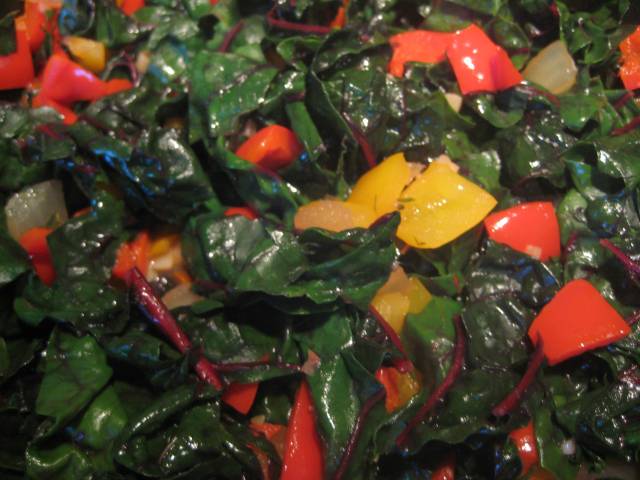
Chard, Red & Yellow Bell Peppers

More and more research is coming to the forefront about the importance of having fruits and vegetables as the major portion of our diets.  According to the Center for Disease Control and Prevention, “At least one-third of annual cancer deaths in the United States are related to dietary factors.  Increased fruit and vegetable consumption can reduce cancer risk, but less than one-third of U.S. adults eat the recommended servings of fruit and vegetables every day.”  Yet, the idea is not new.  Books have been written for years on this subject.  Some say the concept goes back as far as Hippocrates. 

So what exactly is the big deal?  Why are these foods so much better for us? 

To begin, fruits and vegetables are high in vitamins, minerals and fiber.  They are loaded with antioxidants which keep our cells from being broken down so easily by free radicals.  They are nutrient dense.  In other words they are loaded with lots of healthful ingredients and low in calories so you can eat a ton of them, be completely satisfied and still be way lower in calories than you would be when eating junk or processed foods.  Best of all, they provide your tissues with an alkaline environment.     

Alkaline environment… what does that mean?  When foods are metabolized or broken down by the body, they provide the body with energy and leave behind ash.  That ash can either be alkaline-forming or acid-forming; based on the mineral content of the foods.  The alkaline forming minerals are calcium, magnesium, sodium, potassium, iron, and manganese.  The acid forming minerals are phosphorous, sulfur, chlorine, iodine, bromine, fluorine, copper and silicon.    So, those foods that are high in alkaline-forming ash will provide your body with a healthier environment.

If you consume too many foods that are acid-forming, it can wreak havoc on you.  As said by Dr. Theodore A. Baroody, author of Alkalize or Die, “ in my opinion, acid wastes literally attack the joints, tissues, muscles, organs and glands causing minor to major dysfunction.  If they attack the muscles, you could possibly end up with myofibrosis (aching muscles).  If they attack the organs and glands, a myriad of illnesses could occur.” 

Amongst the biggest culprits for acid-forming ash are fast foods, processed foods, refined sugars, drugs, and chemicals.  Proteins such as meat, dairy, and fish are also acid-forming and yet are important in the diet when taken in proper amounts.  Grains and legumes are also acid-forming.  Too many of any of these substances consequently leads to an acid environment in the body and can result in disease, infections and especially inflammatory conditions such as arthritis.   

In addition, we need to have an alkaline reserve in our body for other situations.  Lack of exercise can be acid-forming for exercise helps to regulate the acid/alkaline balance via respiration.  Stress is a big acid-forming condition.  If we are stressed out or angry, our bodies produce large amounts of acid-forming ash.  Since this is quite prevalent in today’s society, offering your body more of the alkaline-forming foods is that much more important. 

As you can see, there is a fine balance.  This balance is referred to as pH or the measure of concentration of hydrogen in the body.  A pH above 7 is alkaline.  Theories vary as to how alkaline our body (ash) needs to be and yet the range is narrow.  Most say a pH of around 7.4 is ideal.  Based on what I’ve read that number can vary slightly and how to measure your precise pH (in your body) is actually quite difficult to determine.  Having said all this, we do need to be on the alkaline side of the chart and this is mostly determined by what we eat. 

Before we get into the foods themselves, let us look at one other major factor – an acid called hydrochloric acid or HCL.  This is the only acid our body actually produces and it is essential to life.  It is the first substance in the stomach that breaks down our foods.  Lack of it and our foods would just be a mass of undigested waste.  Along with water and enzymes, HCL digests protein into the eight essential amino acids vital to life.  Without it, we would not be able to absorb B12 or folic acid.  In addition, this strong acid kills most bacteria that enters our body with the food we eat.  Last, it keeps us alive by maintaining the proper alkaline/acid balance and becomes alkaline itself after doing its job.

Lack of or excess amounts of hydrochloric acid have the same symptoms – heartburn, burning sensation in the stomach.  Most times, people think it is ‘too much acid’ rather than not enough and end up taking anti-acid tablets, thus decreasing the amount of HCL even further.  It is more common that there is not enough HCL.  Hydrochloric acid production starts to decline around the age of 40.  If you suffer from heartburn, are over 40 or have eaten poorly for an extended number of years, you might consider consulting with a nutritionist about taking a HCL supplement.

So now that we know all this, how are we supposed to eat?  To begin, let us look at the side of food that is confusing.  One of the greatest alkaline-forming foods is the lemon.  We often think of a lemon as being very acid in nature and yet the end result is the opposite.  Lemons produce a very alkaline-forming ash due to their mineral content.  As mentioned before, the minerals calcium, magnesium, sodium, potassium, iron, and manganese all end up creating an alkaline-forming ash.  Well, lemons happen to be high in potassium, calcium and magnesium!  See how it works? 

Generally all fruits and vegetables are alkaline-forming while all other foods are acid-forming.  To maintain a healthy body, it is suggested that your diet is a minimum of 70% alkaline and 30% acid-forming foods.  This ratio is even better at 80% to 20% respectively.  If you suffer from any type of disease, inflammatory condition or have a great deal of stress in your life, you might consider upping the ratio to 90% and 10% respectively.  Also, based on the degree of alkalinity to acidity (for example some foods have a greater degree of alkaline or acid), you can play with what you eat.  I have provided a chart showing you most foods.  Simply download this pdf and keep it on your refrigerator.  Last, to make it easy when you are eating out, think about your plate being 70-90% full of vegetables and fruits with the rest of the plate being filled with protein.  You may think this is impossible but just ask.  I often ask for steamed spinach or extra vegetables instead of the bread or pasta they offer.  Usually they are glad to accommodate you.  (For thoughts on grains, listen to this podcast.)

For many of you this might be a new concept and very different way of eating.  I strongly suggest you start slowly.  Gradually add in more fruits and vegetables, with vegetables being the major addition.  At the same time start decreasing the worst of the acid-forming foods first – such as junk food, fast food, processed food, and sugar.  Give yourself several months to make the changes.  Over time you will be amazed how much better you feel and how much more energy you have!

Digestion – The Highway to Health

Health & Nutrition Experts Podcast Series

Digestion is the process of breaking down the foods we eat into absorbable components.  In other words, when we digest our food, we are taking it apart so that our bodies can use all the nutrients that are found within it.  Although this is a normal process, there are a lot of different circumstances that can affect our bodies’ ability to do this fully.  For some people this will show up as indigestion, bloating, constipation and more.  Even the person that proudly says, “I have an iron stomach!  I can eat anything!” actually might have a great deal of digestive issues. 

 So whether or not you think you might have digestive challenges, it is well worth your time to LISTEN TO THIS PODCAST by Dan Butterfield!

Dan mentions these websites for finding local and healthy sources for food:

Eat Wild – Lists in your area pasture fed animal products as well as fruits and vegetable

Vital Choice – Frozen salmon and other natural wild fish as well as canned salmon and low mercury tuna

US Wellness Meats – Grassfed beef and other animal products

Posture Book Provides Insight and Education for Healthy Posture!

I am excited to be launching my posture eBook!  I have been involved in posture through my massage training for almost 20 years.  I wrote this book after seeing the consequences of many postural imbalances – pain, numbness, tingling, weakness, emotional responses, stress, a decrease in energy and much more! 

This book will educate you about how to support good posture, which muscles may be involved in your body and how to assess this, descriptive teachings of how to stretch each muscle as well as exercises to strengthen those that are often weak.  In addition, the book includes video presentations of how to perform each stretch and strengthening exercise.  

Here is a video presentation on stretching one of the muscles in the book:

GO HERE to PURCHASE THE BOOK!

Testimonial from D.M. Shepard, Torrence, California

“As I mentioned, I was a personal trainer years ago and I still refer to my anatomy books to diagnose surprise aches and pains.  Suddenly a couple of weeks ago I developed major discomfort in my left groin and lower back so I limped around my business office for a full week before I searched online for treatment for the iliopsoas muscle.  Your video demonstration reminded me that sitting at a desk all day will reduce flexibility, shorten muscles and over time compromise posture.  The best part of your video was the stretch you demonstrated to lengthen the iliopsoas muscle area.  My discomfort was remarkably improved after only one day of stretching and I just about have regained full range of motion.

The trend these days is for people to live longer lives.  As a professional financial advisor, I have to prepare more ‘preventive’ investment strategies for my clients to stay ahead of potential financial problems later in life.

I see the same ‘preventive’ value for regaining and maintaining healthy posture and stretching flexibility, to assure functionality and better quality of life.  Certainly posture and stretches are cheaper than pills and surgery!

Thank you, Julie!”

October Recipe – Tandoori Chicken with Mixed Vegetables

Tandoori - Cumin, coriander, paprika, tumreic, garlic, chiles, ginger, charmushka, cardamom and more!

This one-dish meal is fast and easy and offers those fantastic tandoori flavors so famous to India.  This dish serves 2 however will be a great leftover.  If you double the recipe to save some, remove ½ at about 10 minutes into the final cooking period.  This way when you reheat the vegetables will not be overcooked.

Ingredients:

7oz         Greek Yogurt

1 tsp      Crème Fraiche

1 ½ T      Tandoori seasoning mix[1]

1 T          Lemon Juice

¾ Lb       Chicken boneless skinless breast, cut into 1 ½“ pieces

1 T          Butter

1-2 T      Olive Oil

2-3 lg     Garlic cloves, minced

1 lg         Sweet Onion, chopped

1 lg         Tomato, chopped into fairly small pieces

1              Red Bell Pepper, chopped in ¾” pieces

1              Carrot, thinly sliced

1              Zucchini, cut lengthwise in quarters and then chopped across into ½” pieces

1              Crooked Neck Squash, cut lengthwise in half and then chopped across into ½” pieces

½ C         Chicken Broth

½ C         Raw Cashew pieces, toasted

Celtic Salt & Pepper to taste

Marinade:

Mix first 4 ingredients in bowl.  Mix in chicken and let marinate for 3-4 hours or overnight in refrigerator.

 Preparation:

Heat a medium or large skillet to medium heat.  Add olive oil, butter, garlic, and onion to skillet.  Sauté for a few minutes until onion is starting to become translucent.  Stir in tomatoes and cook for a minute or so.  Then add bell pepper, carrot, zucchini, crooked neck squash and chicken broth.  Bring to boil.  Add chicken with marinade and mix thoroughly.  Allow it to come to boil, cover and reduce heat to med/low.  Simmer for 15 minutes or until vegetables and chicken are cooked but not overdone.  S&P to taste.  Serve with toasted cashews on top.

Serves 2


[1] You can make your own or go to Savory Spice Shop  and they can mail it to you.  Note on their website the ingredients, in case you want to do it yourself.

October Cooking Tip – Easy ways to chop Onions, Garlic & Shallots

I realize we all have been chopping onions and garlic for years and yet I often come across people doing it in ways that seem fairly labor intense.  For this reason I decided to offer you a video demonstration that includes some tips to make these food staples even better!

In addition, you may not all know about the wonders of shallots.  At Farmer’s Market they are in abundance at the moment and at a better price than other times of the year.  Like onions they store fairly well in a cool, aerated environment.  I bought a bunch and am hanging them in net bags in my basement. 

Here is some information on Shallots  Give these gems a try!

“Although they are similar to an onion, there are some important differences in how shallots are used in French cooking.

  • Less is more. One or two shallots finely chopped are usually all that is needed to add a subtle, slightly sweet flavor to recipes.
  • Go slowly. If your recipe calls for cooking the shallots in butter or oil, you should do so on a low temperature. Just like garlic, shallots can over cook easily. You want them to come out soft and slightly caramelized, not crunchy and bitter.
  • Marry it well. Shallots are especially tasty when cooked with white wine, cream and butter.
  • Substitute. Although there’s nothing like the real thing, if your recipe calls for shallots and you have none on hand, you can try substituting an equivalent amount of red onion.”

Why Healthy Posture is So Important!

Regaining Good Posture

Posture.  Just mention the word and we tend to sit up straighter.  We think of our mothers harping on us as children, ‘sit up, don’t slouch!’  Yet do we really understand the consequences of both good posture and poor posture?  Can we imagine how the world would treat us if our posture were different?  No matter what your posture looks like, you are subconsciously being assessed.  Not to mention the role posture plays on the health of your joints, muscles, energy and more.

Let us look at this in greater depth.  The body is designed to work at an optimal level within gravity.  Joints, bones and ligaments are stacked in such a way to use the least amount of energy to hold us upright, to be able to stand or sit effortlessly.

Have you ever watched a young child sit?  Do you notice they don’t typically lean back in the chair but rather naturally sit quite straight with no effort?  What happens as we go through life that we start to rely on that chair back to hold us up?  Or that we stand in such a way as to put more pressure on our entire being?  These are some of the questions that started to arise as I became professionally involved in health. 

I have been a Certified Massage Therapist for 19 years and involved in health education in various ways for 30 plus years.  I came from an allopathic family.  Although I respect this school of thought, I found myself looking for an alternative way to address health.  With an analytical mind, I approached massage from a therapeutic place.  I started teaching treatment oriented massage shortly after graduating.   My practice brought many clients with various pain complaints.  I started really looking at the whole person in regards to their pain and often found that there were physical issues that often played into all or a portion of their complaints.  This brought me deeper into functional and structural assessment.  I was amazed at what I found.

To begin, posture plays a large role in how we approach life.  If we are hunched over or in pain from poor posture, it shows.  We give off signs of lack of self confidence, lack of intelligence, being overly tired, shyness, and more.  In addition, if our posture isn’t optimal, the amount of energy it takes to go through daily life increases exponentially.  No longer can we rely on the structural body to hold us up but rather our muscles now must be recruited to fight gravity, causing us to expend a great deal of energy.  Our entire being is compromised and energy that should be used to enjoy life is used just to hold us up, literally.

So what really happens?  To start, we have become a sedentary society.  No longer do most of us make our living by working in the fields, walking long distances, carrying packages, and so forth.  Instead we spend long periods of time sitting at a desk followed all too often by sitting in front of the computer or television when we get home.  Our bodies have become lazy.  Some muscles hardly have to work much at all in these situations.  Not only do they not have to engage but, allow them to be in a shortened position for a long enough period of time and they will stay shorten indefinitely.  Other muscles, at the same time, will be in an elongated position with some working overtime and others just becoming weaker.  All this results in our muscles being imbalanced and our joints compromised.  Along with these changes, we can experience pain, burning, numbness, weakness, tingling and more.  Depending on the situation, nerves can be compressed and lead to syndromes such as Thoracic Outlet Syndrome and Carpal Tunnel.   Low back pain, which is all too common, is often a result of poor posture and muscular imbalance.   Consequently the typical answer to these complaints, often result in surgery or pain medications.  Although this might be necessary under certain circumstances, they should never be the first choice of treatment.

Let’s start with looking at the head and neck.  Under normal circumstances, the head should sit right on top of the shoulders, with the correct position being the ear vertically in alignment with the shoulder joint.  Unfortunately all too often the head starts to jut forward.  Some of the common reasons for this are from slouching, trying to read something that is too small (so you lean forward to read it), lack of lumbar support while sitting or from improper positioning of a computer screen.  Our head typically weighs between 12 – 15 pounds; a lot of weight when you think about it and yet if sitting as it should, effortless for the muscles.  Take it out of that ideal position however and multiple problems can arise.  Dr. Rene Cailliet says that for every inch the head is forward of its’ ideal position adds 30 pounds of pressure onto the posterior neck muscles!  In addition, this position can result in:

  • Added pressure to the facet joints of the vertebrae which have a great deal of pain receptors, thus causing pain perception to increase
  • Constriction of blood flow to the muscles, resulting in unhealthy muscles that become prone to injury
  • Tight muscles that tend to refer pain to the head, resulting in headaches
  • The health of the temporomandibular joint causing TMJ dysfunction
  • Carpal tunnel symptoms

Learn stretches to keep your neck healthy!

Let us move on to the shoulders.  Typically the upper back has a slight convex curve.  When in this position, the vertebrae are stacked properly and the ligaments on either side of the vertebrae maintain this position.  As we start to slouch forward, the shoulders tend to round inward.  The muscles in the upper back are in an overstretched position and are now having to work hard to keep you from falling over forward.  The muscles in the front of the chest are becoming shorter with the potential to compress the nerves that innervate the arms.  One of the most common results is known as Thoracic Outlet Syndrome.  In addition, the following complaints can arise:

  • Burning between the shoulder blades
  • Chest pain
  • Shoulder pain
  • Carpal Tunnel syndrome
  • Arm pain
  • Inability to take a full deep breath

Learn how to stretch and strengthen the shoulder muscles!

Next is one of the most common areas of complaint – the lower back.  A great deal of work has been missed in our country from low back pain and much of it can be avoided.  To begin, we will look at the role sitting plays.  When sitting for a long period of time, the muscles in the front of the hips, known as the hip flexors, are in a very short position.  They are used a great deal during walking so they do not tend to get weak, as the upper back muscles, but they do become very short.  This results in changing the normal position of the pelvis and creating what is known as an anterior pelvic tilt.  A small degree of anterior pelvic positioning is normal for women whereas men’s pelvis should stay neutral.  The issues arise when this position is exaggerated.  The pressure tends to be moved posterior to the discs, putting a great deal of pressure on the facet joints.  Remember as mentioned earlier, facet joints are loaded with pain receptors. 

In addition to sitting, the pelvis can end up in an anterior position due to being overweight, especially when we carry our fat in our bellies.  Belly fat puts a great deal of added weight in front of the body.  The only way to compensate for this added weight is to shift the positioning of the pelvis into that exaggerated anterior pelvic position, once again causing an increase in low back pain.

Along with general pain complaints from the low back, the following issues can arise:

  • Hip pain
  • Sciatica
  • Neurological complaints in the legs

Learn to keep your back healthy and strong!

So what do we do about all this?  It would be great if we could move away from sitting for extended periods of time but this is unlikely.  Rather we need to work within the parameters of our society.  The following is a list of ideas that can have a positive impact on our posture thus decreasing or eliminating the negative results of poor posture:

  • Movement or regular exercise:  By getting the blood to flow throughout the entire body, the muscles are receiving fresh nutrients and eliminating waste products.  These waste products in and of themselves can cause pain.  Also by moving, we are taking the muscles through a greater range of motion which can be a start to add length and strength to the muscles.
  • Stretching:  Working to lengthen the shortened muscles before strengthening the elongated weaker muscles will aid in realignment of the skeletal system.  It is important that specific stretches are given in order to lengthen the appropriate muscles.
  • Strengthening:  Once the shortened muscles are working towards being longer, it is then time to add in exercises to strengthen those muscles on the elongated side of the joint.  This is important to allow the body to regain a healthy posture where the joints and ligaments are able to do their job thus decreasing the amount of energy it takes to remain upright in gravity.
  • Ergonomics:  Assessing the position of the person to the height of the desk, the relationship to the chair, the positioning of the computer and so forth is a key.  Only focusing on ergonomics will not change the posture by itself but rather help to maintain the healthier posture with the aforementioned suggestions. 
  • Diet:  Although not directly involved in posture, it does play a large role in the health of the muscles.  Eliminating fast food, sugar, refined foods, soda, excess caffeine and more will enable the muscles to receive the nutrients need for maintaining health.  A healthy diet will also decrease constriction of blood flow thus allowing the entire body to process waste products at a healthier rate.

These are just some suggestions to creating a healthier posture.   Remember posture is much more than just looking good.  By having a body that is fully supported by the appropriate joints and ligaments, we will have more time and energy to enjoy all aspects of life and to live it to its’ fullest.  Isn’t it time to take a good look at your body?

I am excited to tell you that my eBook, Regaining Good Posture IS NOW AVAILABLE! 

Learn about:

  • Which muscles are potentially short or weak
  • How to assess your own body
  • Which stretches you need to do and how to do them
  • Strengthening Exercises to maintain a healthy posture

Included is a video presentation of each stretch and strengthening exercise. 

GO HERE to check it out!

After reading my article on posture, Dr Phil said this:

“Couldn’t agree more – great article examining in detail the importance of good posture. The advice is all spot on.”

He has a great software product called PostureMinder that you might like to check out!

Testimonial from D.M. Shepard, Torrance, California –

“As I mentioned, I was a personal trainer years ago and I still refer to my anatomy books to diagnose surprise aches and pains.  Suddenly a couple of weeks ago I developed major discomfort in my left groin and lower back so I limped around my business office for a full week before I searched online for treatment for the iliopsoas muscle.  Your video demonstration reminded me that sitting at a desk all day will reduce flexibility, shorten muscles and over time compromise posture.  The best part of your video was the stretch you demonstrated to lengthen the iliopsoas muscle area.  My discomfort was remarkably improved after only one day of stretching and I just about have regained full range of motion.

The trend these days is for people to live longer lives.  As a professional financial advisor, I have to prepare more ‘preventive’ investment strategies for my clients to stay ahead of potential financial problems later in life.

I see the same ‘preventive’ value for regaining and maintaining healthy posture and stretching flexibility, to assure functionality and better quality of life.  Certainly posture and stretches are cheaper than pills and surgery!

Thank you, Julie!”