I need your insight!

I was recently at a reunion of my family.  We all got together in Texas where one of my sisters lives.  There were four of us – my mother and two sisters.  This is the first time we have all been together in years.  Every time I do get together with them I am reminded what a different path my life took from that of my sisters.  I first joined a gym in my teens and started becoming aware of health at that point.  My life took me through gradual changes in the choices I made to be as healthy as possible.  I changed my eating habits little by little; gradually eating healthier with each year.  As I learned new discoveries about what to eat and why, I applied them to my life.  Now, years later, I find myself feeling really great with little to no aches and pains.

When I got together with my family, I was especially surprised to see how much my oldest sister had aged.  She complains of rheumatoid arthritis, numbing in the hands, pain in the back, pain in the leg, pain in the foot, swelling in the foot.  I could go on and on as she did for the entire trip.  I not only found it sad that she focused on her poor health so much but was incredibly frustrated that she does not work to eat better.  She knows what I do for a living and what I practice in my daily life.  In fact, she even commented on how healthy I seemed to be and yet whenever I tried to bring up the idea of her starting to make better food choices, she not only ignored it but talked about the burrito that she likes from Taco Bell, about eating pizza, or how she just doesn’t have the time to eat well. 

Now I do realize that there are limitations on what is available depending on where you live yet this particular sister lives in Southern California where the choices are as great as here in Boulder, Colorado.  Given this, I find it baffling why she doesn’t choose to learn more about health – she could read my blog or ask me.  I do know that there are statistics that indicate that what you eat as a young person will most likely affect your food choices as you become an adult.  To some extent I can buy into this.  On the other hand, the two of us grew up in the same household so this tells me that we can also adapt to better choices and habits if we so choose. 

This brings me to the reason for this blog entry.  My ultimate goal is to educate people about health and healthy choices in life.  I really want to find ways to affect people to the extent that they want to become healthy.  I am trying to figure out just what makes this happen.  I did speak with a woman, a friend of my ‘Texas’ sister, about her health.  Apparently she had been very overweight and sick, with lots of pain, for a long time.  At some point she had had enough and started down that path to health.  Today she is a healthy weight, is very aware of what she puts in her body, and seems pretty much pain free.

As far as I can tell my oldest sister must be in as much discomfort and yet still chooses to remain unhealthy.  I am therefore asking each and every one of you that has made the decision to become healthy just what was the deciding factor?  What is it that motivated you to change?  What could I do or say to someone that would really have enough impact to make them want to take a different path?  I would appreciate any and every insight you can offer me.

Thanks and I look forward to your comments!

Julie

What We Feed our Children

There are no two ways about it.  Our children are getting heavier; some even falling into the category of obese.  It is now estimated that one in five children will be overweight by the end of elementary school.  According to the Center for Disease Control, one in three children born in 2000 will develop diabetes.  In fact, early signs of atherosclerosis are showing up in children by the time they graduate from high school.  According to the American Heart Association, studies are indicating that the arterial walls of overweight and obese children looked more like those of a 45 year old person!

This is not right.  As you can well imagine, a large portion of these issues are related to poor dietary choices.  These choices are being made at home but also through school lunch programs.  Unfortunately, a lot of foods that end up in the school lunch programs are based on where the money comes from.  For example in 2005, the USDA allocated 60% of food commodity funds to meat, dairy and egg products whereas only 5% of food commodity funds went to fresh fruits and vegetables.

So what can we do about all this?  It seems we are all so busy it is just too difficult to imagine doing anything other than letting your kids eat the school lunches and/or running by a fast food restaurant and grabbing something quick.  The tragedy in this is that we often don’t really know what is in any of that food. 

I decided to interview a busy mom to see how she handles things. 

Meet Steph, Georgina and Frank

Steph Ryder is a full time mother of 2 that also works part time.  She has a great husband that helps when he can but most of the food choices fall to her.  Her daughter, Georgina is 6’1” at 14 years old.  Needless to say, she plays basketball!  She practices three times a week for about two hours each.  Her son, Frank is about 5’5” at 11 years old and is a major hockey player.  During hockey season, he plays 5 days a week for about an hour per day.  Can you imagine just how hungry these kids are???

Here’s what Steph told me:

JW:  So what is your basic philosophy?

Steph:  I have always cooked at home for the kids.  They are used to eating healthy food; in fact they actually hate fast food!  Although my life is busy, I make a point of preparing their meals.  It really isn’t that difficult.  I put something on the grill and have something with it like fresh vegetables and potatoes.  I also keep healthy food in the house for snacks after school.  Frankie’s favorite snack is a Caesar Salad.  So, I always have everything to make that so when he walks in the house it is available.

JW:  Do you plan your meals in advance?

Steph:  No way!  I don’t have time so I mostly fly by the seat of my pants.  If I am really rushed, I get a whole roasted chicken and serve it with steamed asparagus and potatoes.  I just do stuff that is easy and doesn’t take much time.

JW:  Are the kids picky? 

Steph:  No.  They’re used to eating healthy.  In fact, if we don’t have a lot of time, I go by Whole Foods and let them pick out what they want to eat.

JW:  What do you do for breakfast?  For lunch? 

Steph:  I always cook them breakfast.  It always has some kind of protein, like eggs for example.  I also always make their lunch.  I don’t feel good about what’s available at school so I usually do it myself.  I will make them a sandwich with some fruit, maybe chips and always water.  I NEVER give them soft drinks! 

JW:  What about dinner?

Steph:  They often have practice shortly after school so we tend to eat dinner late afternoon.  As I said earlier, I usually throw something on the grill.  Then when they get home later they might have another snack.  I always keep eggs in the house.  Georgina loves an egg on a bagel.  Then, on Sunday’s we always eat dinner together as a family.  I think this is really important.

JW:  Do you eat out?

Steph:  Hardly ever!  I don’t trust what is in the food.  Besides it is much cheaper to eat at home, even with eating really good food.  For example, I don’t like them to eat meat out because you just don’t know what you are getting.  I don’t want them to get all those hormones and antibiotics that are in a lot of meat!  Also, I try to buy organic whenever possible. 

JW:  Anything else you would like to share?

Steph:  Eating healthy really isn’t that hard.  It doesn’t take that long to prepare.  I think it’s easy.  Also, if we do ever eat out, we never let the kids order off the children’s menu.  The food is always fried!  Instead we have them pick a main course and split it between them.  This was the case when they were younger.  Also, just to emphasize it, I always give them lots of water to drink.  I don’t buy junk.  Oh and I just realized they haven’t been side once this year!

JW:  Would you like to share any of your easy recipes?

Steph:  Sure!

For a fast vegetable dish I sauté zucchini, yellow squash, sweet onion and mushrooms in a little olive oil.  Then, right before I serve it, I drizzle a little balsamic glaze over it.  The kids love it!

I also make a corn dish that they love.  I sauté sweet corn (frozen organic) and onion in a little butter and thyme.  I then cut up a chipotle pepper and add it along with a little of the adobe sauce it comes in.  It has a great spicy taste.

In the winter I make a lot of soups and dishes in the crock pot.  Those are so easy and can be made ahead of time.

JW:  Thanks for taking the time to share all this with me. 

Steph:  Sure.  I hope it gives other mom’s ideas!

May Recipe – Mixed Green Salad with Miso Dressing

This salad is especially great as it is loaded with calcium.  It is a great indication of just how easy it is to get an abundance of nutrients in one easy and delicious dish.

Serves 2

Note that the amount of calcium in milligrams is listed after each ingredient

Salad:                                                                                    Caluium

3 cups       Lettuce Mix                                                        45 mg

1 cup         Watercress                                                         41 mg

3 TBSP       Parsley, chopped                                            15 mg

6 tsp          Sesame Seeds, toasted                                178 mg

2 oz            Feta Cheese[1]                                                280 mg

1 cup         Strawberries, sliced                                         24 mg

Dressing:

½ cup        Olive Oil

                    Or

¼ cup        Grapeseed Oil

¼ cup        Olive Oil


3 TBSP       White Miso[2]                                                     130 mg

3 TBSP       Apple Cider Vinegar

3 cloves    Garlic, minced                                                      15 mg

6-8              Basil leaves, chopped

Total Calcium                                                                          728 mg    Divided by 2 = 364 mg calcium per person!

Blend all dressing ingredients in food processor or blender.

Mix all salad ingredients in a large bowl.  Drizzle salad dressing over to taste, reserving balance of dressing in the refrigerator for future use.  Celtic salt and pepper to taste.


[1] I prefer sheep or goat feta as it is higher in nutrients, lower in fat and easier to digest.

[2] Miso is a fermented soy product.  It comes in a paste and is delicious to add to various dishes.

May Health Tip – Calcium

Of the calcium, 99% is stored in the bones with the balance being stored in the body fluids.  In the bones, it not only acts to maintain a strong skeletal structure but also serves as attachment points for the tendons of the muscles.  The calcium in the body fluids circulates as iodized calcium which helps to regulate muscle contraction, blood clotting, transmission of nerve impulses, the secretion of hormones and the activation of some enzyme reactions.

 Calcium by itself cannot be absorbed by the body.  It needs other nutrients to enable that to happen.  Those nutrients include magnesium, phosphorus, vitamins A, C and D.  An example of this is magnesium.  Magnesium stimulates the production of a hormone called calcitonin.  This hormone is what keeps the calcium in the bones and out of the soft tissue.  It is believed that many forms of arthritis are due to an increase of calcium in the body fluids and a lack of calcium in the bones[i].  Another example is the need for Vitamin D.  Typically we absorb about 25% of the calcium we ingest.  Vitamin D helps to make the calcium-binding protein which is needed in order for us to absorb that 25%.  So as you can see, it is a bit more complex than we think.

To take this a step further, the 1% of calcium in the body fluids always remains the same.  If we are not consuming enough calcium through our diet, the body will actually take the calcium out of the bones to maintain that appropriate level in the fluids.  This process is silent, meaning we might actually not know this is happening.  Unfortunately as we age however, this can show up as osteoporosis. 

With all of this said, it is important to make sure we are getting an adequate amount of calcium and its carriers in our diet.  The average adult should consume between 1,000 – 1,200 milligrams of calcium daily[ii].  This may sound like a lot but it really isn’t!  Let us take a look at what foods actually contain high amounts of calcium.

Of course the dairy industry wants you to believe that their source of calcium is the best.  Although cheese and milk do contain a high amount of calcium, often people are intolerant to dairy.  This can be due to being lactose intolerant, a deficiency in the enzyme that breaks down the lactose in the milk, or because high dairy diets can cause heavy congestion in some people.

Personally I do ingest dairy but try to focus on the use of goat or sheep products rather than cow.  Goat and sheep tend to graze rather than be grain fed.  Grazing increases the nutrient value of the milk as the animals are ingesting more nutrients from the plants.  In addition, the fat molecules of the milk from these types of animals are smaller, thus easier to digest.  They are also lower in fat.

In addition to dairy there are some fantastic sources of calcium.  Below is a list of some of the best:

  • Dried seaweeds such as wakame, kombu, kelp, hijiki, and arame
  • Beans such as soy, garbanzo, mung, aduki, black and lima
  • Nuts and seeds such as almonds, sesame, cashew, and filbert
  • Whole grains such as buckwheat, millet, amaranth, and rye

Of course my favorite source is GREEN VEGETABLES!  Leafy green vegetables not only contain a good amount of calcium but they also contain lots of chlorophyll.  In the center of the chlorophyll molecule is found magnesium.  In addition, chlorophyll is a great source of phosphorus, vitamins A and C.  How can there be a better way of getting your calcium and all its carriers than eating green vegetables? 

Having said all that, let us look at some of the best sources of vegetables for calcium:

  • Mustard greens
  • Turnip greens
  • Bok Choy
  • Kale
  • Parsley
  • Watercress
  • Broccoli

We tend to think of spinach and chard as great sources of calcium as well but surprisingly they are not.  Although they contain a lot of calcium, they also contain oxalic acid.  This substance binds chemically with the calcium thus preventing it from being absorbed.  Now this is not to say that these vegetables are not chocked full of other nutrients, they are!  Just don’t use them as a source of calcium.

So start playing around with ways in which you can increase the amount of calcium in your diet.  Chances are you might be able to take in much more than you think.  This month’s recipe offers you a tasty salad that is high in calcium.  Check it out!


[i] Paul Pitchford, Healing With Whole Foods

[ii] Understanding Normal and Clinical Nutrition, Seventh Edition

Interested in Sustainability?

Early Morning in Leh

Three years ago I had the fortune of finding out about an organization that has been focusing on sustainability, ecology and diversity since the 1970’s.  The organization is called ISEC or International Society for Ecology & Culture.

They have been working in Ladakh, also known as ‘Little Tibet’ since this time.  Ladakh at one time was a place where being 100% self sustainable was the norm.  It has been used as an example and study of what can be an ideal way to live.  I went to Ladakh and volunteered with this amazing organization for 4 weeks, living on a farm and learning about the culture as well as what we can do in the United States to make a difference.  It was a journey that changed my life.

Since this time, ISEC has gotten more and more involved with education around sustainability.  If you are interested in learning more about this subject and organization, I strongly suggest you check out their website.  They have books, videos, and articles.  Of course, if you want a greater experience, you can always volunteer!  Whatever you choose, it is a great resource in a time of great need. 


Village of Phyang
Village of Phyang


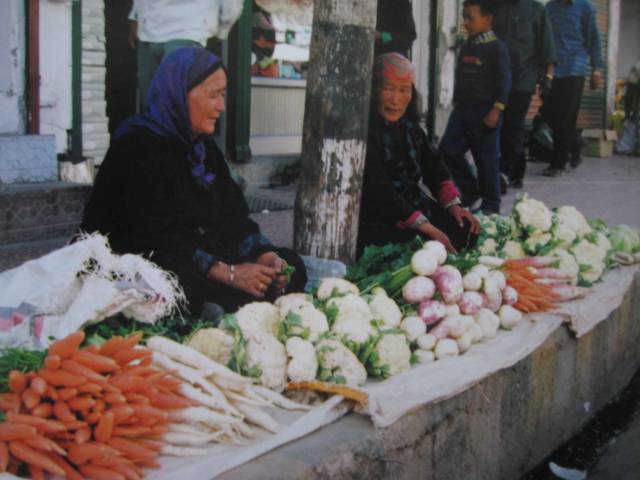
Morning market
Morning market
Ama Le
Ama Le

May Cooking Tip – Roasted Red Bell Peppers


Red Peppers on Sale!


 For the last week or so, Whole Foods have had red bell peppers on sale for 99 cents each.  Unfortunately they are not organic (in fact I find it very difficult to find organic most of the time) but they are really delicious. 

With this kind of sale, I want to purchase a bunch.  Knowing that they won’t last very long, I roast them.  Roasting is a great way to keep them fresh for a much longer period of time in the refrigerator.  Plus I think they taste much sweeter this way!

 Here’s how you do it:

Place the peppers whole on the grill or under the broiler. 

Continue to turn them occasionally until all sides are blackened. 

Remove them and place in a paper bag, close tightly. 

Keep them in the bag for at least 10 minutes. 

Take them out of the bag and remove the skin and seeds.

Place in a glass jar.

At this point you can pour a little olive oil over them, close the lid and shake to coat. 

The other option I really like to do is:

Place in a jar.

Drizzle with a little olive oil.

Add one or two garlic cloves, cut in half.

Add the juice of one orange or equivalent amount of orange juice.

Add a sprig of fresh rosemary, about 6” long.

Put on lid and shake.

Either way you can leave the peppers in the refrigerator for a good week or more.

Enjoy!

Salsa Dancing and Healthy Eating

Julie was interviewed by Jenny and Carlos of Salsa TALK Podcast about eating…

Salsa dancing is not only great fun but it is also a fantastic way to get exercise.  Jenny and Carlos have a regular podcast series where they interview different people on various subjects.  This month they asked me to speak on how to eat healthy before dancing, what to do during, and after.  Check out their site for all kinds of fun information on salsa, some great videos on salsa dancing and a bunch of podcasts including this one.  Check it out here:

SalsaTalksm

Breakfast can be healthy and inexpensive!

As we were sitting at the table talking about the cost of food and the time perception it takes to make a healthy meal, we decided to include this in our information.  So we added up what the cost of the entire breakfast was, excluding the coffee, and determined for the two of us the meal was about $3.50 total.  As for how long it actually took to prepare, it was under 20 minutes.  It was healthy and something we prepared together, making the entire experience that much better.

Here’s what we made and how we did it:

“Scrambled Eggs with Fresh Vegetables, Avocado, Cheese and Blackberries on the Side”

My part:

In a sauté pan, mixed 1 tablespoon olive oil with ½ tablespoon butter

Add ½ chopped onion

1/3   chopped red bell pepper

Add ¼ cup white wine and 1 teaspoon sundried tomato pesto  This stuff is so great to add to vegetables.  A jar will last in the refrigerator for months and you only need to use a little bit at a time, which makes the cost barely anything per serving.

Cover and sauté for 8 + minutes on medium heat until the bell pepper starts to soften

Add 2 leaves of chopped lacinto kale

Sauté for about 2-3 minutes more

Meanwhile:

Cut ½ avocado into long strips to top the dish

Rinse the blackberries

Sam’s part:

Grate about ½ cup Aged White Cheddar Cheese

Scrambled eggs:  place three large eggs in a medium bowl.  Add a tablespoon or so (a guess) of water (milk or half & half can be used).  Add salt and pepper to taste.  Use a fork and vigorously whip this mixture.  In a large skillet (separate from the vegetables) melt a tablespoon of butter (enough to generously cover the bottom of the pan) using high heat.  When the vegetables are almost complete, pour in the egg mixture into the large skillet and be prepared to tend it carefully.  Reduce the heat to medium.  As the egg mixture begins to cook (15 to 30 seconds), using a spatula, begin to push the cooked portion to the center of the pan.  This allows the uncooked eggs to run around the cooked portion to contact the pan.  Keep up this process until no more eggs will run around the cooked eggs in the center.  At this point there should be a little liquid egg on the top of the cooked eggs.  Flip over these eggs so that the liquid part is down.  Turn off the heat immediately and turn out on plates in seconds.  The most important part of making fluffy yummy scrambled eggs is to avoid overcooking them. 

Presentation:

If desire, heat plates slightly on stove so meal is hot when served.

Place the eggs on the plate

Top with sautéed vegetables

Sprinkle with grated cheese

Top with slices of avocado fanned across the top

Serve the blackberries on the side

Notes:

Part of what made this meal so inexpensive is the choice of what was on sale at the market:

Blackberries .88 for 1 pint (Sunflower Market)

Avocado .99 (Whole Foods Market)

Onion – always cheap and so good anywhere

Red bell pepper .99 each (Whole Foods Market)

Lacinto Kale 1.99 per bunch (usually at Sunflower Market but this time on sale at Whole Foods)

So basically our breakfasts often change based on what is fresh and on sale.  This is just what we did this week.  Try this or any combination you like and I think you too will really enjoy it and your body will absolutely love starting the day this way!!